Sunday, September 23, 2012

QWERTY: A Film Analysis

To serve and protect the people. 

The irony to this is shown in QWERTY, a film about the corruption and harassment that lurks in the Philippine police force. It revolves around a cop, Leo Concepcion, on his last day of duty before he departs for Qatar, yet due to unexpected unfortunate events, he gets caught up with the flawed system he works for. Unluckily, he has been wrongly involved in a torture video that went viral. 

As it seems, QWERTY is based on the real-life police torture video in one of Manila’s precincts posted on YouTube two years ago, which caused worldwide indignation and has become the “talk-of-the-town” until today. The video showed a naked suspect with a string on his genitals, grimacing in pain as the Senior Inspector tugs at the string each time the victim fails to answer questions; it was reported later that the man died (Amnesty International, 2010). 

QWERTY blatantly pinpoints the wrongs of the system and various mechanisms were used to achieve such.

There are several significant elements shown, which only proved how much depth and substance the film had, despite reviews and comments saying how pointless and redundant it seemed it was. Palpably, it is done in film noir style – in black and white. 

Pure black-and-white films have become rare as digital technology emerged; thus, there are good reasons why directors utilize occasional black-and-white films. It is interesting to note that QWERTY was not a historical, “flashback” film, yet it was still portrayed in black and white to fabricate the expected film noir. Britannica says that a film noir or “dark film” is a style of filmmaking characterized by elements such as cynical heroes, dark, bleak lightning effects to enhance the drama. Normally, it uses high contrast lightning such as black and white (Encyclopedia Britannica, n.d.). Often, classic film noir create moods such as melancholy, alienation, desolation, disillusionment, pessimism, ambiguity, moral corruption, evil, guilt, desperation and paranoia. It appears that the film contains such atmosphere – dark, desolate and intense. Plausibly, the use of bleak colors, in this case, black and white, can help portray the QWERTY’s theme and narrative effectively.

The black and white element seen in the film seemed insignificant at first and was probably just an effect the director wanted to make it look and feel “dramatic.” However, it was also needed as reinforcement to the suspense and fear that the audience is expected to experience. In QWERTY, just at the beginning of the film, when the credits are being “typed” down just like how the cop types his crime report in the typewriter, one can already sense the invoked fear and bleakness that exists throughout the film, without prior knowledge of the plot. 

Just the mere effect of the grayscale colors, the impact of the film’s violence and brutality is more heightened. For instance, in one scene when Concepcion was off to duty and was on his way to the precinct, he passes through a narrow alley, with the walls trying to cave him in, walking away from the camera. Without narration and dialogues and other explicit mechanisms, the mere contrast evoked the tension and the gravity of the drama. Because of the deep-focus shots, low-key lighting and especially the effect of black and white, such eerie atmosphere and suspense is experienced by the viewer. The high-contrast (black and white) lighting and contrast, therefore, is essential in the composition of the film noir style in QWERTY, bearing in mind that it portrays police violence and corruption. As a result, the brutality of several scenes is enhanced.

QWERTY speaks of polarities – black and white – good and evil. It portrays both the “familiar” picture of a violent, corrupt, inhumane cop like Dela Cruz and the “ideal” noble cops who abide by their principle – “to serve and protect the people.” Thus, although we all have the general perception that police men are corrupt, violent and inhumane, the film portrays that there are still seemingly “noble” cops (well, at least one cop) who disagrees and are displeased with how the “norm” within the police system is perpetuated. They cannot change the system themselves; they either conform anyway or willfully attempt to untangle themselves from it instead. An escape from the police force and a search for a better job abroad may be the only means to be free yet, on his last day of duty, he finds himself enslaved by the system. It seems that once you’re in, you may never be free. Such despair, hopelessness, frustration and extremities can be felt all throughout the movie. The black and white contrast is obviously a huge factor to these seemingly nuisances.

As much as grayscale colors are critical in conveying the message of the film and can indeed be a symbolic artistic expression, the title is also an important metaphor for one to understand the film in its entirety. QWERTY refers to the universal keyboard style used originally in typewriters, computers and mobile phones. It is said that the original keyboard style is not the most functional of designs but to change all keyboards in the world is no longer possible due to its universal prevalence, just like corruption in the police force (DJ Mojo Jojo, 2012).

The 2012 Cinemalaya featured a similar film, Posas. A significant amount of brutality and corruption is also portrayed in the very center of the institution that seeks to eradicate it. Posas contained the same anger and frustration evoked not just by the characters but also by similar dramatic elements such as low-key lighting and akin camera angles. While QWERTY was a full-feature black and white film, Posas did not have the same contrast; it was colored. However, the colors were also bleak and pale, highlighting the torture and the horror experienced by both the victims and the viewers. For instance, in Posas, the darkness of the torture room, where the suspect was gagged and drowned and soaked in, reflected the darkness of how they treated the prisoners. This obscurity can also be found in a scene where they tortured the poor man who was blindfolded and chained, where only sinister colors can be seen. In contrast, in QWERTY, from beginning to end and morning to evening, the colors were always gloomy, since it is black-and-white – probably an amplification of how impious not only the police force was but how the portrayed world is in reality. Moreover, both films also showed the darkness of the alleyways which revealed the many unknown things that take place therein.

Ultimately, QWERTY is an exceptional work of art. With the use of various mechanisms, such as monochrome contrasts, lighting and compositions, the message and the intended artistic expression are effectively expressed in its fullest measure, despite its predictability and redundancy. An intense emotional impact is inevitably cultivated in the experiences of the viewers, at least in mine. Such elements make it not only impacting but it also makes it more real than reality. That, I believe, is the measure of a well-crafted film.

Sunday, January 22, 2012

Is the Internet Making us S2pd?


In an age of instant noodles, McDonalds and digital technology, people now want to get things done rapidly and proficiently. Inevitably, the emergence of Internet has filled the increasing need for more speed and efficiency. It has wrought much change and has become a recurrent subject in most media studies and “talk-abouts.”

The Internet has paved the way for an on-going debate of whether the increasing use of such has become an addiction or simply a natural evolution. Many say that it has made us more competent since more information is available. On the other hand, some critics and scholars have claimed that the harmful effects of the Internet far outweigh its benefits. They argue that it has made us become overly dependent on the Internet and at some level, “stupid.” 

Even so, I believe it has greatly impacted how we think, write and speak but it does not leave us passive and powerless.

According to David Crystal, “the online mode of writing has become especially adopted to the new world of communicative efficiency and rapidity” (Parungao, 2011). In short, our words and phrases have become simplified and shortened because we want to get our and their message across as fast as possible. 

Aside from saying, “by the way”, in Netlingo, we say, “BTW.” In fact, in sending e-mails, even businessmen simplify their messages. “C2C” means consumer-to-consumer, an acronym used to describe the sale and purchase of an item from one individual to another, as in the case of online auctions like eBay (Netlingo.com). Thus, using internet language can be more time and work-efficient, considering how fast-paced our society has become. In this sense, the Internet can be a positive functional medium, allowing us to pool our resources to accomplish more.

However, some see it as harmful and destructive and can, for instance, cause a general deterioration in the quality of language and work. In other words, it can downgrade our intelligence and therefore damage how we think. Instead of reading for context and nuance, the Internet encourages us to merely skim for fast facts that lack substance. 

Critics assume that reading bullet points and Twitter postings turns our thoughts into bullet points and Twitter postings. 

On an extreme note, moreover, there are claims that the internet is not only shaping our lives but physically altering our brains. 

The Internet, as they say, with its constant distractions and interruptions, is turning us into scattered and superficial thinkers. 

Nicholas Carr, a technology scholar, spurred the debate on whether such notion is true and claimed that Google is making us more “dumb." He even supports this claim with biological assumptions. According to him, modern neuroscience shows that our habitual practices can actually change our “brain structures.” 

For instance, the brains of illiterate people are structurally different from those of people who can read. If learning to read could shape human brains, we can assume that our addiction to Internet can do something similar. In fact, according to a study made on its effect on student performance, using the Internet for “recreational purposes” had a negative effect on test performance, particularly for reading scores.

Given the cases illustrating how the Internet and using its language can be harmful, it cannot be denied that it has brought much influence to culture and society. In my opinion, however, the Internet is much influential but it does not leave the individual powerless – overly dependent and therefore, “stupid.”

Critics of the Internet use science to press their case, backing up with research that shows how it can change our brains when in fact, according to Harvard professor Pinker, every time we learn a fact or skill the wiring of the brain changes. It is true though that the pervasive use of the net can be distracting or addictive, especially to people with attention deficit disorder. 

However, if we think about it, distraction is not a new phenomenon. Hence, I argue that instead of bewailing the Internet, the solution must be to develop strategies of self-control, as we do with every “distraction” in life.

The expression of informality in writing has greatly increased – something which has not been seen in English since the Middle Ages. True, it can damage the structural notion of what writing must be. However, I think that as the Internet is becoming linguistically diverse, it is able to reach out to the minorities and their languages. 

In fact, according to Crystal, it has encouraged a dramatic expansion in the variety and creativity of language. More than that, encouraging intellectual depth is the responsibility of universities. 

According to Pinker, “it’s not as if habits of deep reflection, thorough research and rigorous reasoning ever came naturally to people.” Thus, they must be gained in institutions such as schools and maintained with constant upkeep, which we call “analysis, criticism and debate." 

Besides, intellectual competence is not gained by merely propping a heavy encyclopedia on our laps nor are they taken away by efficient access to information on the net.

Information has been increasing immensely and the Internet has been helping us manage, search and retrieve more information, from Twitter and previews to e-books and online encyclopedias. 

In fact, in a study made by the Pew Research Centre’s Internet and American Life project, interviewing a panel of more than 370 internet experts, 81% of them agreed with the proposition that “people’s use of the internet has enhanced human intelligence." 

Elon University’s researcher Janna Anderson said that “there is no doubt that the Internet is making much more information available, instantly, in more formats to more people, thus this tool is definitely enhancing the intelligence of those who are fortunate enough to be able to go online.” 

Far from making us stupid, online technology is a tool for us to acquire a vast wealth of information at the touch of our fingertips. 

My mother told me that to write research papers, she would need many hours to look for the right books and research material from the multi-storied UP Main Library. Today, one doesn’t need that much time because the Internet cuts the time by half.

In my opinion, the individual has the responsibility to filter all information and use what he or she needs. In most instances, the bombardment of information provided by the Internet makes an individual lazy to do critical thinking. 

But the responsibility again lies on the individual to counteract that premise.

Monday, October 3, 2011

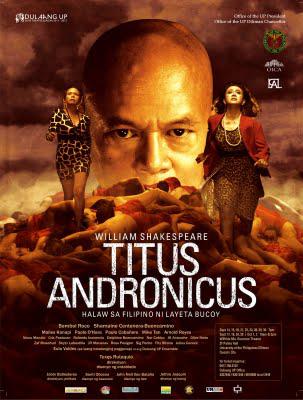
Titus Andronicus: Tinarantadong Asintado


This, by far, is the goriest and most vulgar play I've ever seen. But congrats to Dulaang UP for being so brave and daring, as always. This play is a real definition of art.


Titus Andronicus: Tinarantadong Asintado is basically a story of brutality and violence that has been lurking in the “carnival” of politics and society of our country today. Adapted from the original play of Shakespeare, it is simply a game of revenge among influential families. The story starts with the retired municipal police chief (Carding) who massacred the current mayor’s campaign leaders and their families two weeks before the elections, upon the order of the incumbent mayor’s opponent – the Vice Mayor (Armando). In revenge, the mayor allied with the Castillos including Clarissa to assassinate Carding but instead, Carding’s eldest son was killed. Carding, then, had Clarissa’s eldest son kidnapped. Meanwhile, Clarissa had her revenge on Carding by having his only daughter Salve raped and mutilated (by her sons), and framing Carding’s sons Richie and Rocky for the murder of Armando’s brother Antonio. Carding, then, reached the brink of insanity and butchered Clarissa’s sons and fed it to her. He eventually slays her; Armando kills Carding; Carding’s son Ryan kills Armando; and Ryan becomes the mayor of the town. At the end, they all meet the Clown of life and death. 


Familiar, huh?

Thursday, September 22, 2011

Kurakot, kurakot

I have recently been reading a lot of case studies and been doing a lot of research work (duh, I'm a CommRes major) so I might as well apply what I'm learning.

The P728 Fertilizer Fund case has been dismissed - forgotten, even. And despite of all the facts that have been disclosed, it seems impunity still lingers and cripples our society.

The issue of corruption in the Philippines is gaining more attention and it appears that it is not just a problem of perception but a reality. These days the people witness what mayhem natural disasters could actually destroy the country. Corruption, in comparison, is a continuing manmade catastrophe that is weakening and destroying the nation. The cases of corruption are increasing not just in number but in the amount of money involved. The figures in the big cases now run into hundreds of millions and even billions. The Fertilizer Fund Scam, one of the largest scams in recent Philippine history, has exposed one of the most organized crimes in the administration which has greatly evolved in ugly forms and distressing amounts.
The Senate committees on Agriculture and Food, and Accountability of Public Officers and Investigations (Blue Ribbon Committee) conducted a series of public hearings on a fertilizer fund scam in March 2006 and concluded that agricultural funds anticipated for farmers were diverted by Department of Agriculture (DA) Undersecretary Jocelyn “Joc-joc” Bolante for the 2004 electoral campaign of President Gloria Arroyo.

After numerous hearings and discussions, the Blue Ribbon Committee led by Senator Richard Gordon, issued Committee Report No. 54 last February 26, 2009. Among ma
ny of their findings, they discovered that massive corruption accompanied the distribution of fertilizers all over the country. Commissions were offered to some, demanded by, and given supposedly to, elected and appointed government officials. There were recipients who did not receive a single drop of fertilizer. The P728 million in funds supposedly used for the purchase and distribution of fertilizers to farmer beneficiaries were used instead primarily for the re-election efforts of administration candidates by the Department of Agriculture.

Mr. Jocelyn Bolante was a former undersecretary for finance at the Department of Agriculture shortly after President Gloria Macapagal-Arroyo assumed the presidency at 2001. Previously, the Senate accused President Arroyo of vote-buying by authorizing the release of P728 million funds supposedly for fertilizers to the local government officials. Despite numerous invitations to and cases issued against Bolante, he did not honor nor heed any of them. He was subjected for condemnation for his repeated audacity. He, instead, fled to the United States where he found refuge. Bolante's trip to the US was believed to be an intentional attempt to escape the command of the Senate. His flight was a clear indication of guilt according to Senator Gordon.

According to the Philippine Center for Investigative Journalism (PCIJ) report dated September 2005, the track of nearly 3 billion pesos was released by the Department of Agriculture during the presidential campaign last 2004. The investigation found that big portions of that money were diverted and distributed to congressmen, mayors and governors who were friends of the Arroyo administration. They also found out that a portion of the money mysteriously ended up in the hands of dubious private companies. According to the records of Securities and Exchange Commission (SEC), none of the companies existed. Department of Agriculture insiders, Commission on Audit (COA) investigator and farmers say that the money was directed to the Arroyo campaign and farmers did not receive any centavo of the said funds.

According to former Solicitor General Francisco Chavez, the P728 million was distributed to 105 congressmen, 53 governors, and 23 city and municipal mayors. He showed a list from the Department of Budget and Management (DBM) proving to the releases. He also revealed that some of these beneficiaries actually received cash and not farm inputs, as Department of Agriculture rules had recommended. It now appears from Commission on Audit investigations that part of the agriculture funds went to questionable foundations. In the Metro Manila and Southern Tagalog region, Commission on Audit auditors tracked the funds to groups such as the Gabaymasa Development Foundation, Magsasaka Foundation and Aaron Foundation. Records of the Securities and Exchange Commission said that Gabaymasa's purpose is "to undertake integrated rehabilitation and restoration activities in areas affected by natural and man-made calamities,” but the Department of Agriculture issued to the foundation checks worth P23.1 million, supposedly to receive farm funds in Quezon, Marinduque, Oriental and Occidental Mindoro, Palawan and ParaƱaque. On the contrary, Aaron Foundation is listed in the Securities and Exchange Commission as involving in livelihood projects and daycare centers for street children. It received P5.2 million, supposedly for agriculture projects in Batangas and Palawan. The Securities and Exchange Commission has no record of a Magsasaka Foundation but is listed as the recipient of P6.5 million for farm projects in Palawan. In Visayas and Mindanao, the agriculture funds went to various foundations like Ikaw at Ako Foundation (P13 million for projects in Bohol, Biliran and Agusan del Norte), Philippine Social Development Foundation (P31 million for projects in Agusan del Sur and del Norte and Surigao del Norte), Matatag na Republika Cooperative P3.2 million for Biliran) and People's Organization for Progress and Development, Inc. (P5.2 million for Agusan del Sur and Surigao del Sur).

After years of investigations, the issues concerning the fertilizer scam still has not been resolved. Joc-Joc Bolante and his colleagues remain silent and further charges have not yet been imposed.

According to Senator Richard Gordon, the Ombudsman failed to do its duty whe
n no resolution was made on this case even after more than a thousand days. In the February 2009 Executive Summary of the Blue Ribbon Committee he stated, “We denounce its (Ombudsman’s) inaction in the strongest possible terms. Instead of being part of the solution to corruption and justifying the existence of its office, it has instead become part of the problem, worsened the climate of corruption, and given cause for its abolition. By its blatant inaction and callous behaviour, it would seem as if it has been coopted by the corrupt. It seems that instead of apprehending the caravans of thieves, the Ombudsman has turned a blind eye and has allowed them to go on their merry way.”

Senator Francis Pangilinan also said that the investigation on the fertilizer scam will not end until Bolante, the suspected brains and chief implementor of the scam reveals the truth.

The P728 million involved in the fertilizer scam could have been spent in more important sectors such as the education and health instead of the presidential campaign. The fertilizers could have been given to the farmers in the regional areas rather than in the pockets of a few. The administration should have ensured that the fund will go to the rightful farmer-beneficiaries to boost the country's rice self-sufficiency, which presently stands at 90 percent according to
Senator Loren Legarda. According to the National Food Authority (NFA) last August 2005, more than 1.3 million metric tons of rice contracted by the government through the NFA have arrived the various disports in the country. The budget for rice importation could have been allocated to the rightful farmers. There would be no need for rice importation and there will be enough rice supply. The government should put priority to improve rice production in the country, instead of supporting an assortment of agricultural activities with a few millions here and a few millions there.

The Senate through its Blue Ribbon Committee diligently performed its function to investigate the fertilizer scam but the Ombudsman has been remiss in its duties. The mandate of the Ombudsman is found in Section 12 of Article XI of the Constitution: “The Ombudsman and his Deputies, as protectors of the people, shall act promptly on complaints filed in any form or manner against public officials or employees of the Government, or any subdivision, agency or instrumentality thereof, including government-owned or controlled corporations, and shall, in appropriate cases, notify the complainants of the action taken and the result thereof.” It is therefore puzzling why the Ombudsman has not decided on the cases regarding to the fertilizer scam which have been pending with them for more than 1,000 days. If the Ombudsman had exercised his powers aggressively, the result of the Fertilizer scam and other issues related to it
should have been released and the guilty government officials such as Bolante charged and convicted. According to the Republic Act No. 7080 [an act defining and penalizing the crime of plunder], “any public officer who accumulates or acquires ill-gotten wealth through a combination or series of overt or criminal acts of at least P50 million shall be guilty of the crime of plunder and shall be punished by reclusion perpetua to death. The Court shall declare any and all ill-gotten wealth and their interests and other incomes and assets including the properties and shares of stocks derived from the deposit or investment thereof forfeited in favour of the State.” (As amended by RA 7659, approved Dec. 13, 1993).

President Arroyo also claimed that she was innocent. Assuming she had no idea on the schemes of Bolante, it is puzzling why she tolerated such action. There has also been no instruction from the chief executive to advance the investigation of the Ombudsman. The administration should have taken action in making resolutions on the Fertilizer Fund Scam.

This is not the first corrupt operation that has been committed and if the authorities in the Executive Department are not careful and more prudent, more deliberate, and more careful in the release of funds, this will not be the last. This lack of monitoring by officials in the administration casts a shadow on its integrity.

It’s not surprising then that the Philippines has been rated the most corrupt Asian economy by the Political and Economic Risk Consultancy (PERC). The fertilizer scam is one clear and famous evidence of corruption during the Arroyo administration left unheeded or unpunished. Truly, if we do not put a stop to corruption, we will be fated to continuous dishonor - a reputation most unfair to our people, millions and billions of whom will be forced to find their future in foreign countries.

Hence, the outcome of the scam provides the readers not just the particular wrongs and mistakes committed by certain people. They also lead to the bigger picture of corruption and greed that is so rampant not only now, but which has been intensifying over recent years.

Sadly such corruption left unpunished has a tremendous effect on the trust and faith of the Filipino people toward its government officials. In the June 2009 Pulse Asia Survey, 46% of the Filipinos disapproved the performance of Pres. Arroyo. The fertilizer scandal has resulted to big losses of resources as opposed to the gain of wealth and power of the people in authority. Lastly, it shows us the oppressing schemes of hungry politicians having access to massive amounts of public money and using power and influence without guilt to gain more.


References:

http://www.scribd.com/doc/15330294/Senate-report-on-fertilizer-fund-scam-14th-Congress http://www.scribd.com/doc/12936112/Final-Complaint-vs-Ombudsman http://www.pcij.org/stories/2005/farmfunds.html

Sunday, September 4, 2011

Rizal X

In lieu of our national hero’s 150th birthday, Dulaang UP’s Rizal X is an attempt to showcase different facets of Rizal’s life and works. It aims to reintroduce, and rediscover Rizal to the times we live in, making him more relevant to our generation. However, the play is not just about him but it is also about the characters he brought to life, the people he has changed and the lives he has inspired.

Since it consists of fragments of stories related to Rizal and his works, there were different messages conveyed all throughout. The apparent main message, however, is that through Rizal’s life and influences, we, the youth, should always remember who we are as Filipinos. We should stop being blind and apathetic to the ills of the society because we are the hope of our country. As Rizal’s inspiration and as a people with vision and capable of doing something for our beliefs and ideals, we should continue dreaming and aspiring; we must never forget our roots.


The collection of stories was presented through various media - monologues, dance, music, film, visual arts and vignettes, which I think was helpful in achieving its objectives. Moreover, what made it more successful was the flavor of popular culture, such as the “conyo” and famous trends and songs. Personally, it has convinced me to rethink Rizal and his ideals and what my generation is doing about it.

Although I was able to understand the general theme and message of the play, there were scenes that left me confused. I don’t think there was anything wrong with the concept itself. However, I must say that the flow was messy (either it was intentional or not); the scenes and scenes were somewhat cluttered because it had too much ideas. Thus, it was a bit ineffective in clearly delivering messages; unless, you analyze the scenes closely and replay it in your mind over and over again. The idea of “fragments” must have been tied neatly into a whole or at least needed to be powerful individually. For instance, the scene “La Deportacion” where Rizal’s realizations in Dapitan was presented through a song and dance number did not have much
impact.

Moreover, some dialogues are too compressed that it was difficult to grasp everything the actors are trying to say. In the scene where literal performance of activism and fighting to the death for one’s beliefs was illustrated, the progress of their lines were too fast that one will forget what the previous actor said. Although the scene was artistically depicted, I noticed it ended the audience thinking: what was it about?

However, there were scenes that I appreciate, like the monologue of Rizal’s women. It helped the audience to understand the scene with the variety of their costumes and the actresses’ distinct and clear use of diction. More than that, the execution of scenes was also made more effective by the music and its lyrics. If it weren’t for the music, I don’t think it i wouldn’t be able to understand the entirety of the play.

What caught my attention most was one of the actresses that played the role of the modern “Sisa.” She was one of three women who portrayed the real lives of three mothers who made the headlines in the tabloids for heinous crimes done to them in the course of their work. Personally, I think she stood out among the rest because her acting was believable and realistic. It seemed effortless and her face was very expressive. There was a distinct variety in her expressions, which I think is an important skill in acting. Her diction was very clear and was very colorful. Since she did not only play the role of an abused woman, she had to use different “deliveries” which she was able to pull off. No wonder she easily caught my attention and I was able to connect with her.

Ultimately, Rizal X is a great artistic piece that brings life to our generation. I hope that this production has refreshed dreams and has stirred up the nationalism of young men and women, as it did to me.

Wednesday, March 23, 2011

On the Origin of Man

According to Spencer Wells, a geneticist, the first man lived in Africa.

Based on the DNA analysis from people in all regions of the world, every human today has descended from him, however he left in several waves of migration.

Blair Hedges, a molecular biologist at Pennsylvania State University, says that genetic evidence accurately tells us that humans are of recent origin and arose in Africa.

He proves this by saying that the African populations have the most ancient gene pairs that code for specific traits and the greatest genetic diversity, which means that they are the oldest. Hence, this evolution theory could probably true. However, there is no genetic evidence that supports the idea of intermixing.

Based on Wells’ research, the first men evolved in Africa and gradually expanded to Eurasia.

Eventually, they spread out through Australia, Middle East, Southeast Asia, China and in Europe. This was determined by studies based on the y-chromosome, which is a good tool for population studies because it is basically unchanged though generations except for random mutations.

His evidence based on DNA in the y-chromosome indicates that the migration began between 60,000 and 50,000 years ago. Factors would probably be the increase in population, which stirred competition and innovation; a change in consumption of food, language and more importantly, climate change.

I find it really interesting that such genetic studies are able to conclude the origins of man, with strong and reasonable arguments.

Having to know how all of us are connected amazes me because I have never heard of any accurate biological story ever before.

From the African, the Australian, the Asian to the European, it is proven that we all have the same blood.

It does make sense though if we do really come from the Africans because of how authentic and ancient their culture is until today.

Also, science has proven that the Africans are the oldest people around the globe.

Although these studies are found to be accurate, they are not necessarily true. Because Wells use logic as his method, then it could only be valid but not be true. (It will take another entry to expound on that, so let's just leave it there)

This theory of man is just one of the many theories that geneticists, archaeologists and historians are responsible for. However the dates of expansion and colonization may be correct, they almost appear to be too recent.

I think that most geneticists are getting data that agree with most archaeological and fossil data yet all of the different methods used for dating can generate errors.

Knowing methods of science, more fossils, archaeology and ancient DNA are still needed for the whole picture of human evolution.

However, I think that no man can prove completely without any hint of doubt, insufficiency or error concerning the real evolution of man. It is way beyond human intelligence, no matter how much we try; we are mere humans. Hence, I believe that nothing can be certain, even science cannot be certain.

But I think these studies and analysis are vital in our understanding of one’s beginning and one’s identity, to be able to develop a strong and competent species.

Do you think Adam is African?

Tuesday, March 22, 2011

F.H. Batacan's Smaller and Smaller Circles

Smaller and Smaller Circles was an unexpected delight.

It is a suspense- detective story which reminds me of the television series, “CSI,” only it has a local flavor in it.

The story revolves around the lives of two Jesuit priests, Father Guz Saez and Father Jerome Lucero, in search of the culprit behind th
e serial killings in the community of the Payatas dump site.

It reminded me of the tandem of Sherlock Holmes and Watson. Similarly, Father Gus, the main character, is a forensic pathologist while his sidekick, Father Jerome is a clinical psychologist.

Jerome, the younger priest and a former student of his is more serious and intense with a capricious temper, especially when stuck in traffic jams and meeting with Atty. Arcinas. On the other hand, Gus is calm, relaxed and is very fond of music. Eccentric as he may appear, he likes to listen to Bach, Gregorian chants, the Doors and the Sex Pistols when examining corpses.

The murderer is seething with rage within his shy and aloof personality which was shown in the latter part of the story. All throughout the novel, it felt like I was reading the mind of a serial killer, of a psychopath.

It pushed me to dwell deeper than the glimpses of horrifying images and watching a terrifying story unfold. As the reader is brought into the mind of a psychopath he eventually understands how he thinks and his psyche.

In fact, the story begins sinisterly and the first picture the reader sees is the world through the eyes of the killer - “I feel like I’m always being watched. I hate being watched.”

In my opinion, it is the mind of the killer that is the driving force of the story and not the curiosity of what may happen next. Throughout much of the novel, the killer is a phantom whose voice haunts the reader in alternating chapters, which I think contributed to the dread and suspense, by filling the presence of a character the reader does not see until the end.

No wonder it is difficult to put down. I actually finished it in one sitting and that doesn’t happen very often. I suppose that is the best thing about the book is that it is a fast read, in spite of its careful attention to details.

Every detail was uniquely illustrated by the author that I even forgot how good a Sherlock Holmes book was. It felt so real, as if I was seeing the dead bodies myself with their faces peeled off and chests bastardized.

It was evidently well-written, with wit, good choice of words and use of clear images and other artistic elements to draw the reader towards the story.

For instance, the title “Smaller and smaller circles” was a metaphor used to illustrate the paranoia of the murderer. Similar to that of a piece of bread or a piece of cheese he feels like he is encircled by rats, scuttling around him and watching him. These rats, apparently in his mind are the two Jesuit priests, assisted by the NBI and a reporter named Joanna Bonifacio.

Furthermore, I also think that the familiar setting helped readers to appreciate the story.

Painted by the weather, the dumpsite, the kids and the streets, the story obviously took place in the Philippines, particularly in Quezon City where the actual Payatas dumpsite is located. A Filipino can instantly imagine the places, the weather, and especially the characters. Because Filipino readers are familiar with the Quezon City area and places such as Katipunan, Payatas and even Ateneo, the story becomes alive and real.

The seemingly rain-and-shine weather also contributes to the Filipino background. The setting is close to my dorm so I can easily picture each scene as if I was watching a film.

Moreover, I appreciate how the author used foreshadowing in the story. In my opinion, the side-story of Father Saenz’s impacted tooth and the scene when they saw the medical mobiles served as the keys to unraveling the mystery of the crime.

Although it was written in a comedic way, it was actually showing a possibility that the suspect is affiliated with medicine.

On the other hand, what I didn’t like about the story was the Latin phrases, French conversations and Italian musings which didn’t serve any use at all. It had no significance in the story. It could have hindered the reader from completely appreciating the book. It could have discouraged him because it creates a feeling of exclusion.

“Smaller and Smaller Circles” contains so much sentiments of rage, with characters inflicting this kind of yoke – the murderer against his former P.E. teacher and classmates whom his victims represent.

However, underneath it all is the “rage” toward poverty which is very evident in the Philippines. Atty. Arcinas, for instance, pushes himself up the ladder of fame and success because he wants to forget his roots in the notorious slums.

The murderer lives pretentiously as a middle-class dentist because it enables him to hunt down the “tweenish” boys who remind him of his past friends who like him were all abused by a P.E. teacher in Payatas. Carlos, the culprit, unfortunately also came from a poor family.

The book undoubtedly allowed the reader to become so engaged and involved - creating an illusion that he is part of the happenings.

I cannot help but feel goosebumps as the author pictures out the bodies and how the poor boys were killed.

Moreover, I also liked how the author was able to illustrate the realities of crime scene investigation in the Philippines. He was able to cite the scarce merits and numerous flaws of our investigating system.

At the same time, he was able to suggest the capabilities of the Filipino mind – whether elimination or creation of crime.

However, nonetheless, it is still a gripping detective story. The scenes appear to become so alive and real that it is captured clearly by the reader - the vivid, powerful and elaborate descriptions of people, places and situations instill the story in his mind.

Ultimately, the story is a breath of fresh air in a culture bombarded with obscure poetry and mushy and overly sentimental short stories and novels. Smaller and Smaller Circles is definitely an authentic Filipino masterpiece.